

Five things every UK airport needs in place for environmental compliance
Published: 3 November 2026
Environmental compliance at an airport comes down to five ongoing capabilities. They cover almost every risk a regulator, insurer, or senior leadership team is likely to ask about. We set out what each one involves, what happens when it's missing, and why it belongs on the operations agenda as well as the sustainability one.
1. A Regulation 61-ready monitoring and reporting programme
The Environment Agency has issued Regulation 61 notices to around 25 commercial airports in England. These notices formally require airports to survey, screen, sample, and report on PFAS, hydrocarbons, de-icer, and other pollutants in surface water, groundwater, and trade effluent against fixed deadlines.
Many airports are now through their 12-month sampling programmes, and the results feed into the Environment Agency's wider review of airport discharge permits. Airports that had no monitoring before the notice arrived started from zero, with no baseline or history to show the regulator alongside the new results, and they go into that permit review in the same position.
That calls for a standing monitoring and reporting programme covering the pollutant sources a notice will ask about: site surveys, pollutant source identification, a screening procedure, ongoing sampling, and a surface water risk assessment that is kept up to date rather than built under deadline pressure. A notice with 12 months of monitoring data behind it is a conversation. A notice with nothing behind it is a scramble that pulls estates, engineering, and legal teams off everything else they're doing, with enforcement action on the table if deadlines slip.

2. A PFAS strategy that goes beyond one round of testing
Decades of aqueous film-forming foam use at fire training areas have left many airports with PFAS in soil, groundwater, and surface water. Defra published the UK's first PFAS Plan in February 2026 and the HSE has consulted on restricting PFAS in firefighting foam, so scrutiny is only heading one way. Airports that treat PFAS as a single testing exercise get a result, usually confirming there's a problem, without a plan for what happens next.
A proper PFAS strategy starts with a conceptual site model showing where the contamination is and how it moves, followed by proportionate remediation. Treating contaminated water on site using methods like granular activated carbon and ion exchange tackles PFAS in groundwater and surface water without the disruption of digging up and disposing of soil across a live airfield. Excavation on an operational airfield means access restrictions, safety permits, and programme delay, while on-site treatment lets the ground stay in use.

3. Drainage treated as a managed asset, not a buried one
Airport drainage networks are often decades old, incompletely mapped, and carry everything from surface water run-off to glycol and hydrocarbons towards a discharge point. When nobody knows the network's capacity, the first sign of a problem is usually a flood or a pollution incident.
Drainage mapping and CCTV surveys establish exactly what exists and what condition it's in. A planned maintenance cycle of jetting, interceptor cleaning, and cured-in-place pipe (CIPP) or patch lining then fixes problems before they become failures. A drainage failure doesn't stay within the environment team's remit; it floods an apron, backs up into a hangar, or turns into an emergency call-out. Planned maintenance costs far less than emergency repair, and it doesn't happen at 2am during a weather event.
4. Fuel infrastructure on a planned lifecycle
Fuel farms, tanks, skids, and pipework are some of the highest-consequence assets on an airfield, and many are ageing faster than airports are replacing them. A leak or failure is an environmental incident, a safety issue, and an operational shutdown while it's contained and investigated.
These assets need managing across their whole life: design, installation, inspection, cleaning, lining, bunding, and maintenance, through to safe decommissioning at end of life. Working to a plan instead of repairing things after they fail also prepares the airport for sustainable aviation fuel and other new fuel types, which can put new demands on ageing infrastructure.
Unplanned downtime hits the airfield directly, and at worst means no fuel and no flights. A planned maintenance and replacement cycle keeps fuelling reliable, and the airport learns the condition of its assets through inspection before a failure forces the issue.
5. Glycol control and lagoon monitoring treated as one system
De-icing puts a large, concentrated volume of glycol into drainage networks over a short winter season, and it typically ends up in the same attenuation lagoons and balancing ponds that handle hydrocarbon and PFAS run-off. If nobody is monitoring the lagoon in real time, a discharge consent breach is found after the fact, usually by a regulator.
Mapping pollutant sources and putting drainage controls on de-icing areas, alongside ongoing chemical and water quality monitoring of lagoons and surface water, shows what is already in the system and flags problems before they become breaches. Sediment surveys, depth checks and localised treatment belong in the same standing programme instead of being left as a seasonal afterthought.
Winter is already the most weather-constrained, time-pressured part of the airport calendar. When the drainage and lagoon system is monitored and understood, de-icing can run at the volume operations need without a compliance problem surfacing once the season is over.
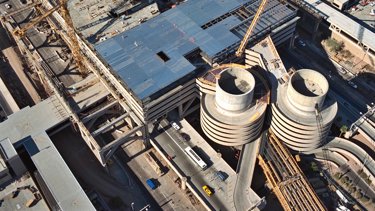
Putting it together
None of the five stands alone. Drainage carries what the fuel farm and de-icing pads produce. PFAS strategy depends on knowing where drainage and lagoons take it. Regulation 61 reporting is only as strong as the monitoring behind it. Airports that run all five as one connected programme, instead of five separate problems with five separate suppliers, can answer from the same evidence.
That's how we work with every airport we support: one team accountable for drainage, PFAS, fuel infrastructure, lagoon monitoring, glycol management, and Regulation 61 compliance – from the first assessment onwards.
More from our Knowledge Hub



Here to solve your biggest challenges and grow sustainable value
Our expert consultants are available to broaden your thinking, lead transformation, and help you achieve successful outcomes.
Contact our experts