

Turning environmental awareness into action: 8 defining conversations from ESS Expo 2026
Published: 24 September 2026
We returned to the Environmental Services & Solutions Expo (ESS Expo) this year with a significantly expanded stand presence and an extensive programme of expert-led presentations designed to tackle some of the environmental sector's most pressing challenges.
Continuing its growth as one of the industry's flagship events, ESS Expo 2026 brought together thousands of professionals across eight co-located exhibitions to share ideas, exchange experiences, and explore practical solutions to environmental challenges. It was an opportunity to showcase the full breadth of our Group capabilities while listening to the concerns, priorities and aspirations of organisations navigating an increasingly complex environmental landscape.
Across two days of conversations, demonstrations and technical sessions, one clear theme came through again and again: organisations are actively seeking to connect their understanding of environmental risks with practical ways to address them. Awareness is no longer the constraint; action is.


Here are the eight themes that defined this year's event – and the evidence from our own project delivery and speaker sessions that backs them up.
1. Waste management, characterisation, and disposal
"We know we have waste, but we're not always sure exactly what it is, how hazardous it is, or what the most cost-effective and compliant route is for managing it."
Conversations ranged from contaminated PPE and oily solids to chemical and battery waste, hazard classification, WM3 assessments, and circular economy recovery routes. The pattern was consistent: organisations know they're generating waste, but not always what it is or what to do with it. A recurring theme was the need to understand the most cost-effective and compliant route for managing it, but also how moving waste as a key consideration to the earlier stages of proposal development can help reduce costs and offer a broader range of solutions.
2. Water and wastewater infrastructure resilience
"How do we improve performance, reduce failures and extend asset life while maintaining compliance?"
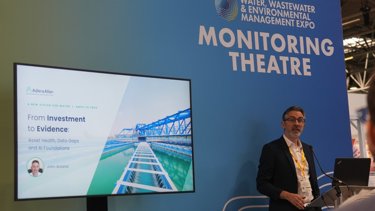
Water supply security, drainage investigations, CCTV surveys, lining, syphon cleaning, and pump/valve maintenance dominated conversations with operators. This links directly to a shift that we set out in our session on the WWEM monitoring stage, "From Investment to Evidence: Asset Health, Data Gaps and AI Foundations". The sector has moved from an investment-led definition of success – spend committed, ambition stated – to an asset health-led one, where the only thing that counts is demonstrable condition and evidence that withstands scrutiny.
As the session put it, "where evidence is missing, risk is not absent – it is simply undeclared." Eight converging pressures (procurement delays, skills shortages, financial constraints, data fragmentation, supply chain capacity, regulatory expectation, climate demands and legacy asset condition) are compressing delivery at the same time, and AMP8 onward will be judged on what operators can evidence, not what they've spent.
3. Environmental monitoring and digital insight
"How can we move from reactive management to real-time visibility and early intervention?"
Remote monitoring, IoT sensors, alarm systems, and real-time environmental intelligence were a recurring thread for interceptors, drains, water networks, and industrial processes alike.
Our session on the CLR technical stage, "The Cost of Getting It Wrong: Making Smarter Asset Decisions", framed this as three pillars, moving organisations from reactive response to early detection of failures before they become incidents:
Data-driven visibility (the insight)
Compliant inspection regimes (the action)
Proactive risk mitigation (the outcome)
Together, they turn monitoring from a compliance exercise into an early-warning system, catching failures while they're still cheap to fix.

4. Spill response, incident management, and emergency preparedness
"If something goes wrong, how quickly can we respond, minimise environmental impact and maintain compliance?"
Speed was the recurring pressure point for industrial, utility, and public-sector attendees alike: when something goes wrong, how fast an organisation can contain it, limit environmental impact, and stay compliant determines almost everything that follows.
Throughout the event, we shared many examples of what that looks like in practice – including a fire at a substation with direct connectivity to an adjacent river which triggered 12.5 million litres of firefighting water and 12,500 litres of aqueous film-forming foam onto site. The response team deployed 44 temporary tanks (roughly 3 million litres of containment capacity) within days, followed by a structured drainage remediation programme that achieved a 99.1% reduction in PFAS mass and a regulator-endorsed closure pathway.
5. PFAS and emerging contaminants
"How do we prepare for increasing regulation and liability associated with PFAS and other emerging contaminants?"
Few topics attracted more attention, but the conversation has genuinely moved on. It is no longer, "What are PFAS and will regulation change?"; it's, "How do you manage risk while the regulatory picture is still evolving?"
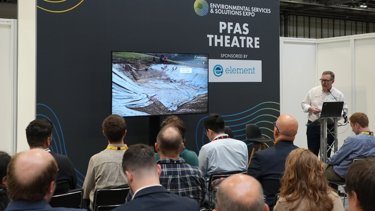
We shared three project examples in our session on the PFAS stage, "(PFAS) Beyond Talk - What It Really Takes to Assess, Remediate and Manage", that illustrated what that looks like in practice:
Lease surrender, oil storage complex: Due diligence uncovered 4,000 litres of PFAS-containing foam additive plumbed directly into the site's fire main, with inadequate bund containment. Targeted investigation ruled out widespread contamination and gave the client a clean baseline for the next tenant.
Lagoon renewal, airport fire training ground: Average PFAS load reduced by 68%, maximum load reduced by 88%, 35 drainage defects repaired, and all contaminated waste streams destroyed – all without disrupting live airport operations.
Post-fire drainage remedials, electricity substation: 99.1% reduction in PFAS mass, verified through a level 4 detailed quantitative risk assessment, with compliant drainage reinstated and the asset returned to service.
To put the scale of what's being detected into perspective: the UK drinking water threshold for 48 PFAS compounds – 0.1 µg/l – is equivalent to one pinch of sugar dissolved in an Olympic swimming pool. As one of our speakers put it: "The question is no longer whether you need a PFAS strategy. It is whether your strategy is actionable and how soon you act."
6. Land quality, remediation, and environmental due diligence
"How can we understand and manage environmental risk earlier in the project lifecycle?"
Consultants, developers, and infrastructure organisations kept returning to the same challenge: understanding and managing environmental risk earlier in the project lifecycle, before it hardens into cost or delay.
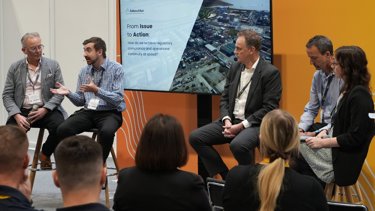
This was the central question of our CLR keynote panel session, "From Issue to Action: How Do We Achieve Regulatory Compliance and Operational Continuity at Speed?", too – how organisations, regulators, and technical specialists move from prevention and assessment to remediation at pace, without compromising compliance or continuity, by aligning stakeholder priorities rather than treating them as competing requirements.
7. Technology, data, and AI-enabled environmental management
"How can technology help us reduce risk, improve efficiency and make better-informed decisions?"
Interest here was less about the technology itself and more about what it enables: reducing risk, improving efficiency, and making better-informed decisions.
AI does not correct weak source data, inconsistent asset hierarchies or unclear ownership – it scales them and gives them fluency. Poor foundations don't disappear at scale; they get amplified and polished, which is the real risk in a regulated environment. The advice: start from a defined problem and a measurable outcome, not an AI ambition – and fix the data fundamentals first.
8. Sustainability, compliance, and regulatory readiness
"We understand our environmental responsibilities, but need practical support to meet them efficiently."
Infrastructure, transport, and industrial attendees consistently framed this as an efficiency problem, not an awareness gap: they understand their environmental responsibilities and need practical support to meet them efficiently.
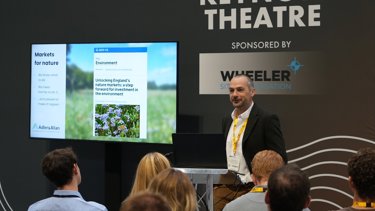
Our GEO keynote session, "Contaminated Land & Ecology: Key Considerations for Successful Development", added a sharper edge to this: the UK's natural environment is valued at over £1.5 trillion and delivers more than £36 billion in economic benefits every year – yet UK species have declined by around 19% since 1970, with nearly one in six now threatened with extinction. Public investment (£1.4 billion through Environmental Land Management schemes in 2024–25) is running well ahead of private investment (roughly £95 million), against government targets of £500 million by 2027 and £1 billion by 2030. Nature markets were framed as one practical mechanism to close that gap, turning environmental compliance from a cost centre into an investable asset.
From insight to action
Across all eight conversations, the same shift underpinned everything: attendees don't need convincing that the risk was real; they need a credible, costed, evidenced route from where they are to where they need to be – whether that's a PFAS liability, an ageing asset, a data gap, or a compliance deadline.
Whether you caught us on the stand, sat in on one of our sessions, or missed us entirely, if any of these themes reflect challenges your organisation is navigating, our experts are here to help.
Want to discuss practical, real-world environmental risk management?
Whether you caught us on the stand, sat in on one of our sessions, or missed us entirely, if any of these themes reflect challenges your organisation is navigating, our experts are here to help.

More from our Knowledge Hub
 Insights
Turning environmental awareness into action: 8 defining conversations from ESS Expo 2026
 Insights
Environmental resilience will decide who wins the UK data centre race
 White paper
The Resilience Dividend: How Environmental Resilience is Becoming a Competitive Advantage for Data Centres
 Insights
Why provable data is becoming the water sector's next competitive advantage
Here to solve your biggest challenges and grow sustainable value
Our expert consultants are available to broaden your thinking, lead transformation, and help you achieve successful outcomes.
Contact our experts