
A roadmap for the future of flood resilience and what leading organisations will do differently
Published: 14 April 2026
Looking ahead to the future of flood resilience, what does great look like in the decade to come? How will the most forward-thinking organisations manage flood risk? What will set true leaders apart? And most importantly, how do you get there?
Here’s what will define the most resilient, future-ready organisations.
Real-time data at the heart of improvement
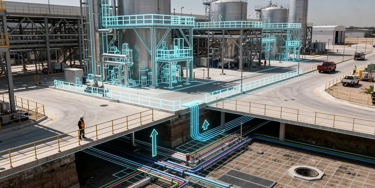
Leaders will move beyond site-specific plans to catchment-aware, system-level models that include asset interdependencies and compounding weather effects. Resilience won’t be reviewed annually, it will be managed daily. Periodic inspections will be replaced with continuous insight – a live, data-driven view of how the estates of leading organisations behave day to day.
- Sensors monitoring drainage and high risk areas
- Telemetry that flags problems before they escalate
- Analytics spotting patterns and early warning signs

These organisations will prevent failures, cut emergency callouts and, have the ability to plan with confidence. The smartest operators will build this insight into their everyday decision making, not just their flood plans.
They will stress-test operations across scenarios, prioritise investment where it reduces risk system-wide, and make better decisions about land use, layout, redundancy and contingency capacity, elevating resilience planning from site to portfolio level.
For the best organisations, resilience will have become inseparable from asset management.
Governance, compliance, and the evolving regulatory horizon
With flood resilience cutting across environmental, planning, discharge, and reporting regimes, leading organisations will have strong internal governance to maintain clarity over obligations and keep audit-ready records of decisions, inspections, actions and outcomes.
Embedded governance will enable these organisations to stay ahead of regulatory change, demonstrate due diligence, reduce legal and reputational exposure, and provide assurance to boards, regulators and communities.
Resilience as a partnership model
Future-ready organisations will have cultivated long-term, strategic partnerships to strengthen their ability to anticipate, respond to, and recover from disruption.
These partnerships will be continuous and relational, helping leaders interpret new data, maintain preparedness during quieter periods, innovate in response to new risks or regulations, and ensure decisions are aligned across the full resilience ecosystem.
Together with operations, engineering, sustainability, governance and finance, these external partners will guide strategy, approve plans, and learn from each incident.
Blending engineered and nature based interventions
The winning portfolios will combine engineered reliability (such as bunds, barriers, pumps, and hard-edged drainage) with nature-based adaptability (such as wetlands, swales, infiltration features, and multifunctional green space) and smart water management to coordinate flow, storage and release.
Decisions will consider flood performance, carbon, biodiversity, and whole-life cost – replacing fragmented fixes with integrated design. Future leaders will make sustainable drainage systems (SuDS) and nature-based solutions central to their portfolios.
Continuous learning as culture
The best organisations will treat every incident – even minor ones – as an opportunity to learn, refine and strengthen. They will review each incident through structured after-action processes, share learnings across teams and sites, refresh plans as new insights emerge, and treat resilience maturity as a journey, not an endpoint.

2026-2030 leadership roadmap
Building true flood resilience doesn’t happen overnight. It’s a progression from understanding current risks to embedding real-time intelligence and operating a fully integrated, future-ready resilience model.
Here's an outline of how organisations can move from early action to sector-shaping capability between now and 2030.
Now (0–12 months)
- Establish baseline risk across sites
- Understand the flood warning services available in your area and what each alert level means for your operations
- Deploy continuous drainage intelligence on highest-risk assets
- Establish a cross-functional resilience group and governance framework, including strategic partnerships
- Run tabletop exercises and readiness drills; align suppliers and emergency partners
Mid-term (12–36 months)
- Expand monitoring estate wide; integrate alerts with operational workflows
- Build system-level models and link to digital twins for scenario planning
- Deliver a hybrid portfolio of engineered and nature-based interventions
By 2030
- Operate a 'predict, prevent, protect, perform' model (measured recovery time objectives, near-miss reduction, insured loss ratio, critical asset uptime)
- Move from site-centric to portfolio-optimised resilience, informing CapEx and insurance strategies
- Share data and methods to shape sector standards, not just meet them
The future belongs to the prepared
Flood risk will continue to rise, but so will the capability of organisations that invest early, think systemically, and act collaboratively.
By 2030, the leading organisations will be those that think of resilience not as a technical fix but as a capability – something they practise, improve and embed across the whole business.
Leading organisations won’t be those who handled flooding well last winter; it will be those who built resilience every day into the way they work, think and invest.
More from our Knowledge Hub
 Insights
Turning environmental awareness into action: 8 defining conversations from ESS Expo 2026
 Insights
Environmental resilience will decide who wins the UK data centre race
 White paper
The Resilience Dividend: How Environmental Resilience is Becoming a Competitive Advantage for Data Centres
 Insights
Why provable data is becoming the water sector's next competitive advantage
Environmental compliance today, creating a sustainable tomorrow
Helping you reduce risk to the environment and your operation by managing assets compliantly while achieving commercial, ESG, and net-zero goals.
Contact our experts